

The best excuse B2B marketing has ever had
Ahead of CIM Scotland Conference 2026, where he'll be joining an expert line-up of speakers, Mark Choueke shares his perspective on why AI isn't changing what great marketing looks like – it's creating an opportunity for marketers to redefine their role and demonstrate greater commercial impact.
By Mark Choueke, Partner and Chief Creative Officer, OrbitalX
I spoke to a former colleague this morning. She’s now the VP Marketing for a £30m cyber business. It was lovely to catch up with her but once we started talking about work, it felt like a version of a conversation I’ve had four times this week already.
“AI is here… budgets are in the toilet…teams are tiny compared to the fully stocked functions we used to work and marketing is being asked to do more with less.”
Plenty of people are talking about this like it's a threat.
I think it might be the best excuse we've ever been handed.
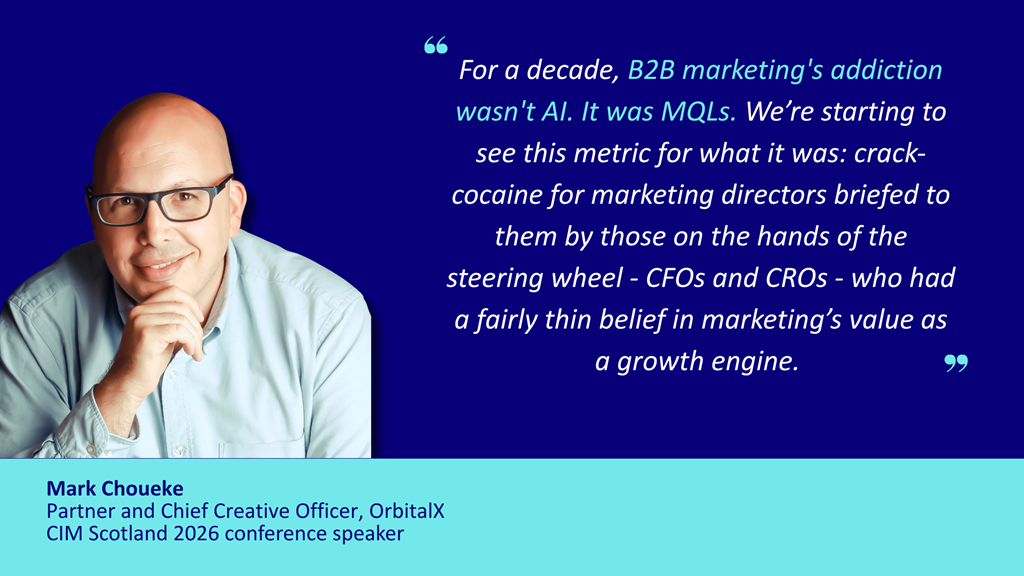
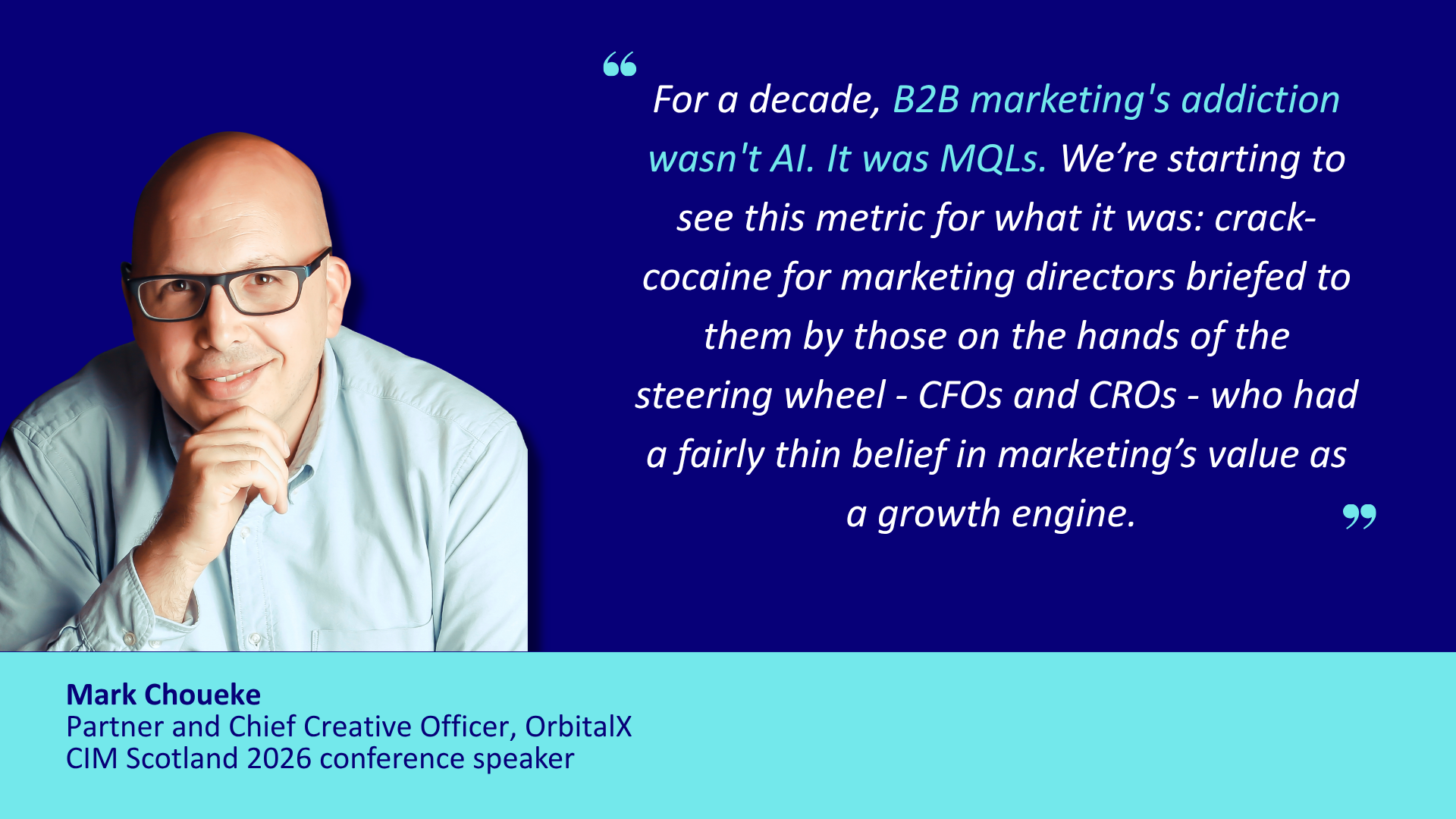
For a decade, B2B marketing's addiction wasn't AI. It was MQLs. We’re starting to see this metric for what it was: crack-cocaine for marketing directors briefed to them by those on the hands of the steering wheel - CFOs and CROs - who had a fairly thin belief in marketing’s value as a growth engine.
So we’d hand sales a fat batch of these MQLs every quarter, revel in the quick hit of achieving target (and of course our bonus) and walk away feeling like a hero; all the while sales would ‘loudly’ work out half these leads were destined for nowhere. It was pure volume dressed up as value.
The need to do more with less has forced every one of us to trim some important skills and capacity but also - if we’re honest - some fat.
Smaller teams, tighter budgets, fewer campaigns - it’s been a difficult shift but I’d be lying if I tried to deny there’s a part of me that doesn’t feel a sense of satisfaction with getting the job done; designing a new function fit for the next 10 years.
 What terrifies me more than working to chunkier targets with smaller budgets? Well, imagine doing all that hard trimming and editing; all that refocusing, and then landing right back on MQLs as our holy grail at the finish line. What an enormous waste of a genuinely good crisis that would be.
If my 18 months of talking to the best B2B marketers around the world on OrbitalX’s Do More With Less podcast has taught me anything, it’s that often the crisis and the opportunity are the same shape. By sheer luck, AI and shrinking resource are converging to push marketing into the actual centre of the go-to-market strategy. We’re no longer the department that generates leads that sit somewhere between ‘hopeful’ and hilariously unqualified.
We’re becoming the function that generates ICP-qualified pipeline and are measured on closed-won revenue. These are metrics that can't be gamed.
This is huge. If you’ve been in B2B marketing for a while, you’ll understand the significance of this chance to be right where we’ve always argued we belong.
For me (and many of my guests on the pod), making it real needs two things. You’ll have guessed the first: we need to be obsessed with where technology can propel us into the future - and as obsessed with where we shouldn’t shoehorn it into elements of our jobs and processes in which it has no business.
The second thing we need is a new bravery: the bravery to claim and own an unfamiliar central role in the revenue mission instead of waiting to be invited into it; bravery to bring something to that table a spreadsheet can't - instinct, creativity, spark, a genuine read on the customer. And the bravery, above all, to be resilient enough to ignore the doubters and let a campaign run for as long as it actually needs to.
B2B buying cycles now stretch nine to twelve months. Buyers are leading us through THEIR journey, on THEIR timeline, researching us long before we ever hear from them. And still, the average campaign gets pulled for review after 30 to 60 days because "the numbers aren't there yet."
If your buyer needs the better part of a year and your campaign doesn't survive nine weeks, you sabotage your chance to make marketing matter to your organisation before it even had a chance to put its shinpads on.
AI didn't create this moment but it did just take away our last excuse for avoiding it. Smaller teams, sharper technology, one real metric, and the nerve to let it play out.
This is the best version of our jobs we've ever been offered.
The themes explored in Mark Choueke's article will continue at CIM Scotland Conference 2026, where marketers from across the profession will come together to explore the trends, challenges and opportunities shaping the future of marketing.
Hear from Mark alongside an expert line-up of speakers as they share practical strategies for navigating AI, answer engine optimisation (AEO), changing customer expectations and the evolving role of marketing. Through a mix of keynote sessions, interactive workshops and networking opportunities, you'll gain fresh perspectives, practical ideas and valuable connections to help you drive impact within your organisation.
Join us this September for a day of learning, inspiration and thought-provoking discussion.